Quick start
- Plant: Phalaenopsis (moth orchid) — the one sold in flower, at grocery stores and as a gift.
- Light: bright, indirect. In the Northern Hemisphere, an east window is usually safest; a south window works with a sheer curtain. A north window is often too dim to rebloom.
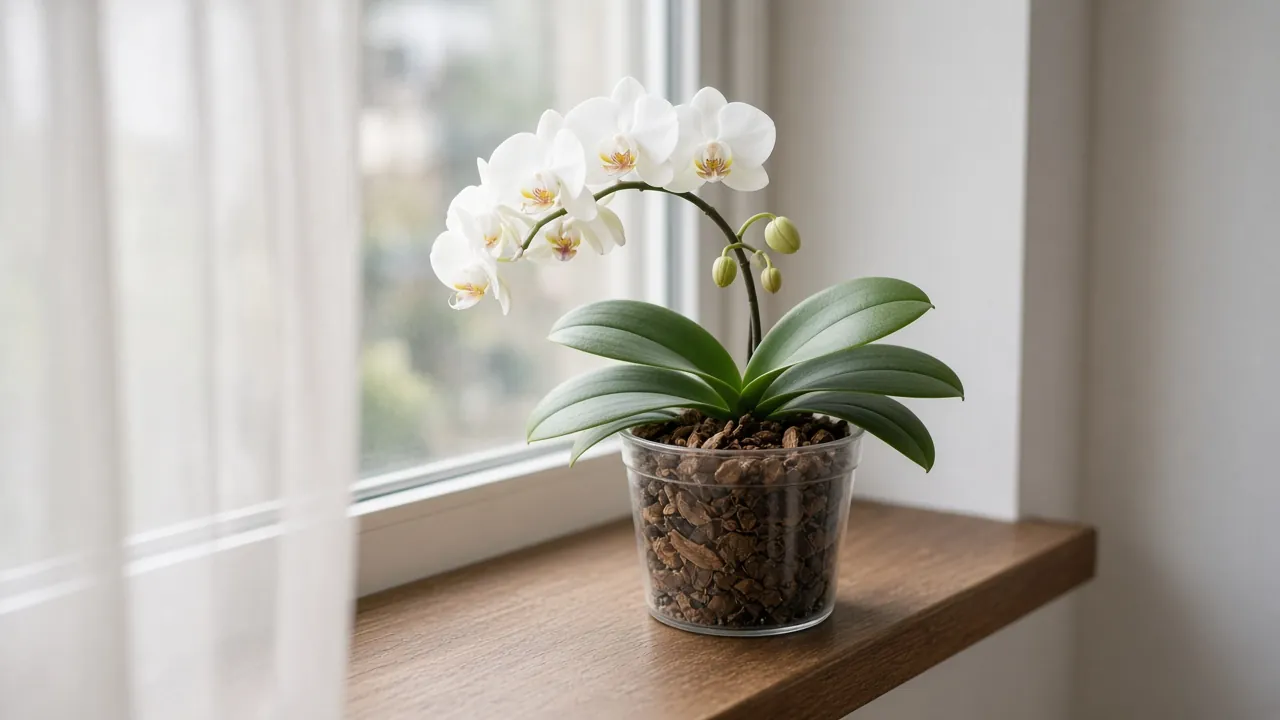
- Pot and mix: a pot with drainage holes (clear plastic helps); orchid bark, never regular potting soil.
- Water: when the mix is nearly dry, with room-temperature water, until it runs out the bottom. Empty the cachepot. Skip the ice cubes.
- Biggest apartment problem: a decorative outer pot that holds water, plus dry heat from a radiator or vent.
In this article
The orchid most people bring home is already in bloom, squeezed into a tight pot, dropped into a pretty cachepot, and left on a coffee table far from a window. The flowers last, then the plant fades, and it is easy to assume orchids are disposable. They are not — but a moth orchid in an apartment has a short list of non-negotiables: the right window, a mix that can dry, no sitting water, and some humidity once the heating comes on. This guide is written for that plant, in that home, not for a greenhouse bench.
Start with the orchid you actually have
If the label says Phalaenopsis, or if the plant has broad, paired leaves and an arched spray of flowers, you have a moth orchid. That is the right species for a windowsill. It is an epiphyte: in nature it perches on tree bark with its roots in air, not in garden soil. The pot has to copy that, which is why bark mix matters and why potting soil slowly kills it.
Cattleyas, dendrobiums and oncidiums show up in shops too. They often want more sun or a sharper wet-dry cycle than a typical apartment can give. If this is your first orchid, stay with Phalaenopsis and learn that plant well.
What you need before you repot
- A pot with drainage holes, only about 1/2 to 1 inch (1–2 cm) wider than the root mass. A pot that is too big stays wet.
- A clear plastic pot is worth it for moth orchids: you can see root color and how wet the bark is. It can sit inside an opaque cachepot, as long as you lift it out to water and never leave a reservoir underneath.
- Orchid bark (medium grade). You can add a little charcoal or sphagnum if your apartment air is very dry, but do not pack the pot with moss alone unless you already know how fast it stays wet. Do not use all-purpose potting soil.
- Clean scissors or shears, wiped with isopropyl alcohol.
- A slim stake and a soft tie if the plant still wobbles after potting.
Repot when the flowers have finished, or sooner if the bark has broken down, smells sour, or the roots are black and mushy. A plant in full bloom can wait unless the mix is already failing.
How to pot a moth orchid
- Ease the plant out of the old pot. Squeeze a flexible plastic pot or cut it if roots have glued themselves to the sides.
- Rinse the old mix off with lukewarm water. Throw away bark that crumbles or moss that has turned to sludge.
- Read the roots. Healthy Phalaenopsis roots are firm; they look green when wet and silvery when dry. Cut away only what is soft, hollow, or dark. Clean the tool between cuts.
- Let cut surfaces air for 30 to 60 minutes in a shady, airy spot.
- Set a little coarse bark in the bottom if you like, then a nest of mix. Seat the plant so the crown — the point where the leaves meet — sits just below the rim, never buried. Fill around the roots. Shake the pot to settle the bark; do not compress it.
- Stake loosely if the plant tips.
- If you cut roots, wait about a day before the first watering. Then water until it drains, and let it drain fully.
The roots need air as much as they need water. Tight, packed mix is how apartment orchids rot even when you “hardly water them.”
Which apartment window actually works
Light is what decides whether the plant only hangs on or makes a new flower spike. Moth orchids want bright light without hot midday or late-afternoon sun on the leaves.
In the Northern Hemisphere, a south window is the brightest and often works with a sheer curtain. An east window, with morning sun, is the most forgiving. A west window can scorch in the afternoon. A north window is the weakest: the plant may live there, but it often stays a deep, dark green and never spikes. (This is the opposite of the advice for Brazil and other places in the Southern Hemisphere, where a north window is the sunny one.)
Keep the leaves off hot or icy glass. A plant pressed against a winter pane can get chilled; one against unshaded summer glass can burn.
Quick leaf read:
- Dark green, floppy leaves and no spike: not enough light. Move it closer to the glass or to a brighter exposure.
- Yellowing leaves, pale patches, or crispy edges: too much direct sun. Pull it back or filter the light.
- A medium, grassy green is what you want.
A bright bathroom with a window can work if the plant still gets a dry-out between waterings. A coffee table in the middle of the room almost never has enough light to rebloom, even if it looked pretty when the flowers were new.
Watering: skip the ice cubes
The ice-cube habit is everywhere on grocery-store tags in the United States. It is a poor way to water a tropical orchid. The cold can stress the roots, and three cubes rarely wet the bark evenly or flush fertilizer salts out of the pot. Use room-temperature water, soak the mix until water runs from the holes, and drain it. That is the method orchid societies and extension services recommend.
Do not water on a fixed weekday. Bark in a small plastic pot on a humid summer windowsill dries at a different speed than the same pot next to a radiator in January. Use three cues instead:
- Weight. Lift the pot right after a thorough watering and again a few days later. When it feels clearly lighter, it is time.
- Root color in a clear pot. Green means there is still moisture; silvery means you can water.
- Touch. Push a finger about an inch (2–3 cm) into the bark. If it is still damp, wait.
Take the pot to the sink, out of its cachepot. Water, drain, then put it back only when the saucer or outer pot is dry. Standing water around the roots is the most common way these plants die in apartments. Try not to pour water into the crown, the joint at the base of the leaves; water that sits there can rot the center of the plant.
Winter heat, humidity, and getting it to bloom again
Central heating and wall vents dry the air just when daylight is also at its weakest. Moth orchids are more comfortable with humidity around the mid-40s percent or a bit higher, which many heated apartments undershoot. You do not need a greenhouse. A humidifier in the room, a group of plants, or a pebble tray — pebbles and water in a saucer, with the pot sitting on the pebbles, not in the water — is enough. Daily misting of the leaves does little and can spot the flowers. Keep the plant out of the direct blast of a heat vent, radiator, or air-conditioning unit.
Feed weakly. A fertilizer labeled for orchids, or a balanced houseplant fertilizer at a quarter of the label rate, every second watering during active growth, is plenty. Once a month, water with plain water only, to rinse salts out of the bark. Do not fertilize a plant you have just repotted, or one with damaged roots.
A new spike usually appears when the plant has enough light, healthy roots, and a modest drop between day and night temperature — something many windowsills already provide in fall. There is no ice-cube trick that replaces those three things. After the last flower drops, you can cut the spike at the base and let the plant rebuild, which is the safest option, or cut just above a node on a still-green spike and hope for a smaller secondary spray. If the spike turns yellow, cut it at the base.
A well-sited moth orchid often rebloom in 8 to 12 months. If it has gone a year and a half without a spike, fix the light first. That, not a special fertilizer, is usually the missing piece.
Common problems in a small apartment
- Black, mushy roots and lower leaves turning yellow: overwatering or broken-down mix. Repot, cut the rot, and wait until the new bark is nearly dry before watering.
- A soft, dark crown: water sat in the center of the plant. Stop watering from above the rosette. A collapsed crown often cannot be saved.
- Wrinkled leaves and persistently silvery roots: underwatering, or very dry heat from a vent.
- Pale patches or burned tips: too much sun, or fertilizer that was too strong.
- White, cottony mealybugs in leaf joints: isolate the plant, wipe with alcohol on a cotton swab, and check weekly until they are gone.
FAQ
Can I plant an orchid in regular potting soil?
Not a Phalaenopsis. Ordinary soil stays wet and smothers the roots. Use orchid bark or a mix made for epiphytic orchids.
How often should I water?
There is no weekly number that fits every apartment. In a warm, bright room the bark may dry in about a week; next to heating in winter it can dry faster on top and stay wet underneath, which is why weight and root color beat the calendar.
Will a grocery-store orchid bloom again?
Yes, if it gets bright indirect light, a mix that dries between waterings, and roots that are not sitting in a wet cachepot. The flowers it came with are the cycle it already finished; the next one depends on your window.
Are ice cubes ever okay?
It is better not to use them. Room-temperature water, applied until it drains, wets the roots evenly and rinses the mix. Ice is a workaround for overwatering, not a care method.
Do I need a humidifier?
Only if the air is very dry, which is common in heated apartments in winter. A pebble tray or a room humidifier is more useful than misting.